Scripts
Eight fundraising call scripts, and why each part works
A script won't make anyone give, but it keeps the caller on the few things that do: a reason this person is hearing from you, one clear ask and a next step that gets written down. Below are eight marked scripts, with the reasoning behind every part. Change the words to fit your voice and keep the order.
What makes a fundraising call script work?
A fundraising script works when it's short enough to say naturally, specific to the person and built around one ask. Learn the opener and the ask close to word for word, let the middle be a conversation, and rehearse short answers to the replies you hear most, such as “send me something,” “not right now” and “I already gave.”
Every script below follows the same order:
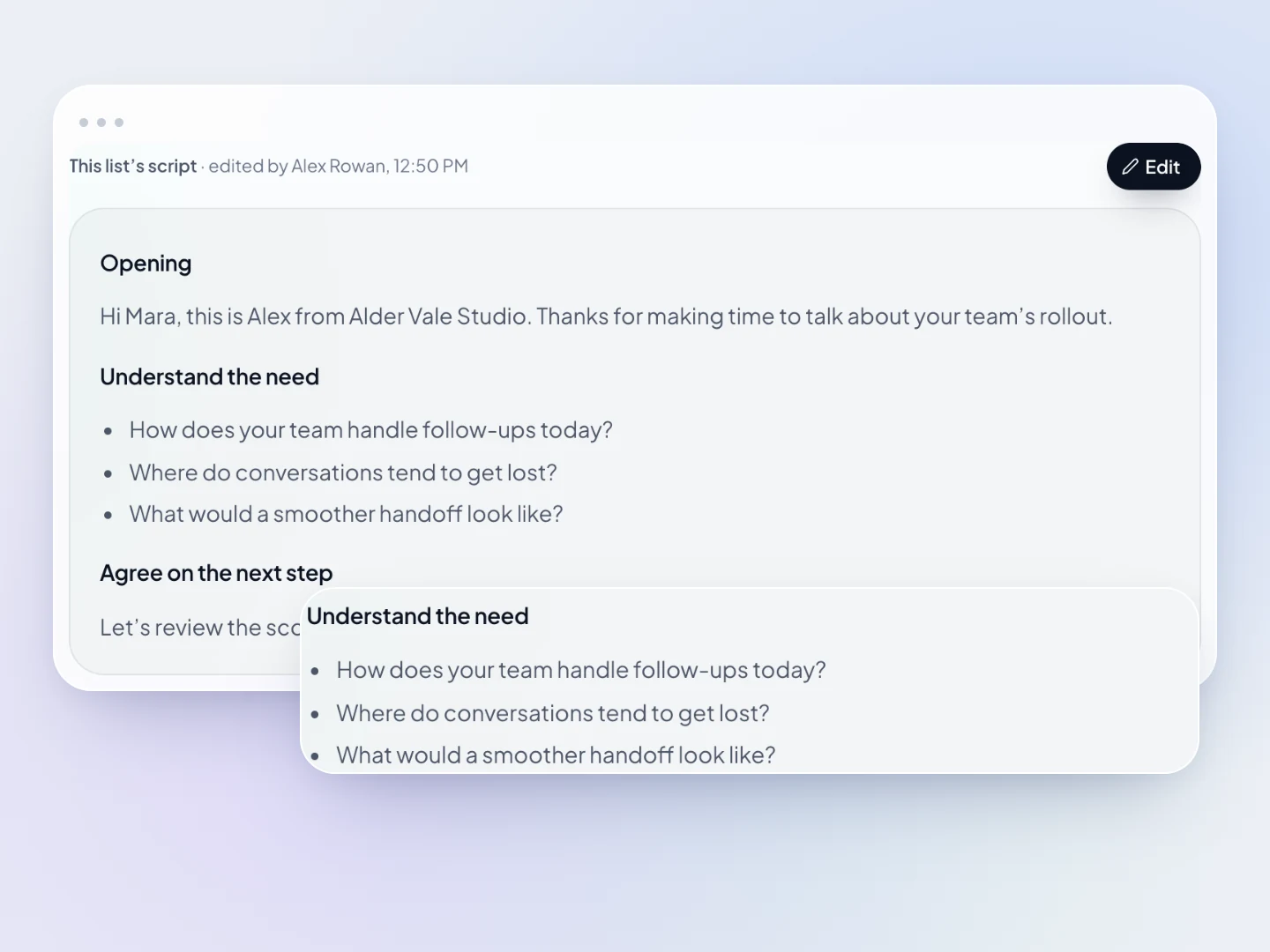
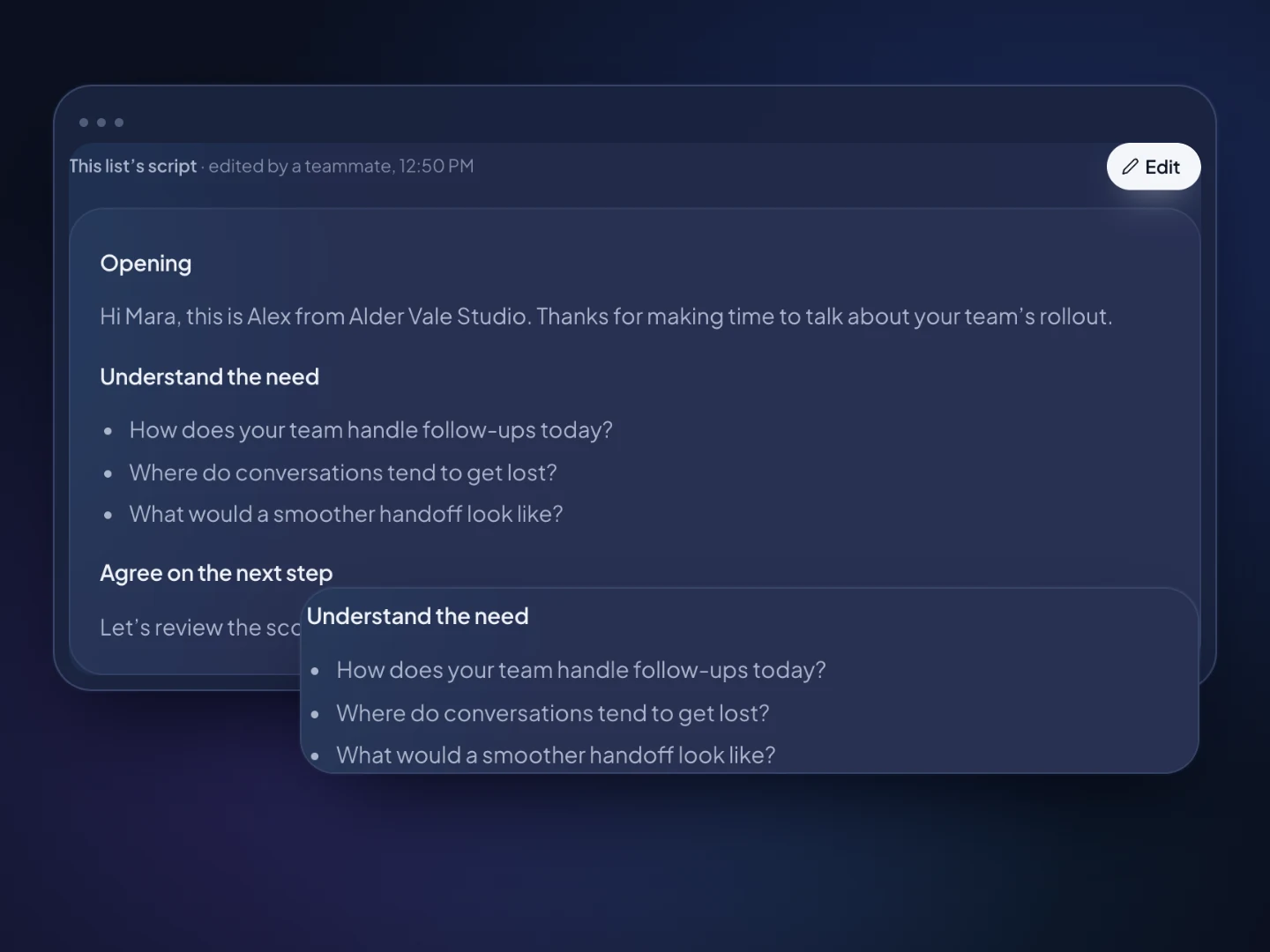
Example: a call list’s script in TopReach
- Open with your name, your organization and a check that it's a good time. Asking permission respects their time.
- Give the reason for this person: a past gift, a past deal, a mutual contact. It answers the listener's first question: why me?
- Make one ask, with an amount or a date. A vague ask gets a vague answer.
- Stop talking after the ask. The silence feels long to you and normal to the person deciding.
- Close with the next step: what you'll send, and when you'll follow up.
- Log the outcome before you dial again. TopReach shows your script in a Script tab next to the call outcome: read from it, then save the outcome and a one-line note to the contact's timeline, where the next caller will read it first.
What should you say on an investor intro call?
On an investor intro call, your job is to learn about the investor and earn a second conversation, not to pitch. Spend most of the call asking questions.
Script 1: Investor intro call (10 to 15 minutes). For a first conversation with an angel, family office or prospective LP, usually after an introduction. For a 30-second cold opener, see the investor outreach playbook.
- Opener: “Hi [first name], it's [your name] from [firm]. [Mutual contact] suggested we talk. Is now still good for fifteen minutes?” Why: naming the introducer borrows their trust, and confirming the time sets the call's length.
- Their story: “Before I tell you about us, how do you invest today? What size check is typical, which stages, asset classes or markets do you like, and how do you hear about opportunities?” Why: people talk more freely about themselves than they listen to a pitch, the answers fill the fields you'll sort by, and for a US private offering, knowing their finances and experience bears on whether you have a substantive relationship.
- Your one-minute version: “We [what you do] for [type of investor or customer]. Our last [deal, fund or round] [one fact you can document].” Why: one documented fact beats a list of claims and keeps you away from promises about returns.
- The ask: “Would it be useful if I added you to our investor updates and called when we have something that fits what you described?” Why: permission to stay in touch is easy to grant, and under Rule 506(b) it keeps a first call from becoming an offer to someone you've just met. If you're raising now and counsel is comfortable with the introduction, ask: “Can I send the deck and find 30 minutes next week?”
- Close: “I'll send [what you promised] today and check in [specific time].” Why: a dated next step turns a contact into a relationship.
How do you follow up with an LP who hasn't committed?
Call with a reason: answer an open question, share one true update on the raise and ask for the next step with a date. A follow-up that only checks in gives the LP nothing to act on.
Script 2: LP follow-up (3 to 5 minutes). For an investor who has the deal package or has soft-committed but hasn't signed.
- Opener: “Hi [first name], it's [your name] at [firm]. I'm following up on [deal or fund], which I sent over on [day]. Have you got a few minutes?” Why: tying the call to something they received makes it a continuation.
- Open question: “What questions came up when you went through it?” Why: it invites the real concern. “Did you get a chance to look?” invites “not yet” and ends the call.
- Update: “Since we spoke, [true update: a lead investor signed, the lender issued terms, the share of the raise that's committed].” Why: real news gives them a reason to decide now, and invented urgency or overstated demand is a securities problem as well as a trust problem.
- The ask: “Documents go out on [date] and we're aiming to close by [date]. Should I put you down for [the amount they mentioned]?” Why: an amount and a date turn interest into a decision.
- If they hesitate: “What would you need to see to be comfortable?” or “Is anyone else part of this decision, and would a call with them help?” Why: hesitation often hides a specific question, or a spouse, partner or advisor you haven't met.
- Close: “I'll send [item] today and call you [day] after you've talked it over.” Why: you hang up with the next call already agreed.
How do you ask a donor for a gift on the phone?
Thank the donor for something specific, tell one short story about what their support does, then ask for a specific amount and wait.
Script 3: Donor ask (3 to 5 minutes). For a current donor in an annual or year-end campaign. For the program around it, see the guide to donor calling.
- Opener: “Hi [first name], this is [your name], a [volunteer or staff member] with [organization]. Do you have two minutes?” Why: your role up front sets honest expectations.
- Thanks: “First, thank you. Your gift last [season or year] helped [specific program].” Why: a specific thank-you shows you know who they are.
- Story: “This year, [one person, one result, in two sentences].” Why: one concrete story carries more than a list of figures and gives the ask a reason.
- The ask: “Would you consider a gift of $[amount] this year for [specific use]?” Why: an amount based on their last gift, or a modest step up, is easier to answer than “anything you can.”
- Silence: wait for their answer. Why: filling the pause with “or whatever works” lowers the gift before they've decided.
- Replies: if yes, “Thank you. Can I text you the link now?” If not now, “Would a smaller gift, or one later in the year, work better?” If they ask not to be called, say “Of course” and add them to the do-not-call list right away. Why: every reply has a next step.
- Close: thank them again, whatever the answer.
What do you say to a lapsed donor?
Thank them for past support, ask what's changed and listen before you ask. A lapsed donor stopped for a reason, and the call goes better once you know it.
Script 4: Lapsed-donor reactivation (3 to 5 minutes). For a donor who gave in a past year but not this one.
- Opener: “Hi [first name], it's [your name] from [organization]. I'm calling to thank you for supporting [program] in [year], and to tell you where it is now.” Why: it states the real purpose and leads with thanks, not a request.
- The question: “What drew you to [organization] back then? Is it still something you care about?” Why: the answer tells you whether their interests changed, their finances changed or nobody asked.
- Listen and log: note the reason on their record. Why: “moved,” “lost a job,” “too much mail” and “forgot” each need a different follow-up.
- Update: “Since then, [one concrete thing their gift helped start].” Why: it connects their old gift to something that exists now.
- The ask: “Would you consider renewing at $[their last gift, or less] this year?” Why: their last amount, or less, makes it easy to come back. An upgrade can wait until they've given again.
- If not: “Thank you for telling me. Would you like to keep hearing from us, or would you rather we stopped calling?” Why: a clear choice keeps your list clean and respects the donor.
What does a candidate say during a call time ask?
The candidate opens with the personal connection, gives one reason the race needs money now, asks for a specific amount and stops talking. A staffer handles everything after the yes.
Script 5: Political call time ask (2 to 4 minutes). The call sheet supplies the name, connection, giving history and ask amount. For how sessions and call sheets work, see the guide to political call time.
- Opener: “Hi [first name], it's [candidate name]. [Connection] said I should call you. Have you got two minutes?” Why: a personal call from the candidate is why call time works, so say who you are first.
- Why now: “We're [true, specific reason: a reporting deadline on (date), an ad we need to fund].” Why: a concrete need with a date gives the donor a reason to act today.
- The ask: “Can I count on you for $[amount] before [deadline]?” Why: a specific amount within the donor's remaining limit, with a deadline, is the heart of the call, so check their room under the limit first.
- Silence: wait. Why: a candidate who rushes to fill the pause talks the ask down.
- If they hesitate: “Would $[lower amount] today, and more later in the cycle, work?” Why: a step down keeps the conversation going.
- Close: “Thank you. [Staffer] will text you the link right now.” Why: the link goes out while the call is fresh, and the candidate's job ends at the yes.
- After the call, the staffer logs the pledge and sends the link. Contribution limits and donor information rules, such as collecting employer and occupation from larger US donors, stay with the contribution page and your compliance staff.
How do you follow up on a pledge that hasn't been paid?
Assume they forgot rather than changed their mind. Remind them what they pledged, make paying one step and ask for a day.
Script 6: Pledge follow-up (1 to 2 minutes). Use it for a donor or call time pledge a few days after the call, when no gift has arrived.
- Opener: “Hi [first name], it's [your name] from [organization or campaign]. I'm calling to thank you again for your pledge of $[amount] on [day].” Why: thanks first, and the amount and day confirm what was agreed without sounding like a collector.
- The check: “I haven't seen it come through yet, so I wanted to make sure the link reached you.” Why: it blames the link, not the person, which makes “I forgot” easy to say.
- The help: “I can text it to you again right now.” Why: removing a step does more than any reminder.
- The day: “Would today or tomorrow be easier?” Why: a choice of two days gets a commitment without pressure.
- If they've changed their mind: “Thanks for letting me know. Would a smaller amount work, or should I take the pledge off our list?” Why: a pledge that won't be paid is better closed than chased.
- In TopReach, a pledge can sit on the deals pipeline with its amount, and an unanswered reminder call can trigger a voicemail drop, then a text or email on the days you choose. TopReach doesn't process payments, so a staffer moves the pledge to received when the gift arrives.
What should a fundraising voicemail and follow-up text say?
A voicemail should give your name and organization first, one reason to call back and your number twice, in under 30 seconds. A follow-up text should name you, mention the call and carry one action.
Script 7: Voicemail (20 to 30 seconds). Variants: for a donor, “calling to thank you and share one quick update”; for call time, the candidate's voice and the deadline; for an LP, the deal or fund by name, without terms.
- “Hi [first name], it's [your name] from [organization], [your number].” Why: if they stop listening after five seconds, they still know who called and how to reach you.
- “I'm calling about [one reason tied to them: your gift last year, the deal you asked about, the event you came to].” Why: a personal reason earns a callback.
- “I'll send you a short [text or email] with the details.” Why: the message that follows arrives expected, not cold.
- “You can reach me at [your number]. Thanks, [first name].” Why: saying it again, slowly, saves a replay.
- Script 8: Follow-up text (one SMS segment). Investor: “Hi [first name], it's [your name] at [firm]. I just left you a voicemail about [deal or fund]. Details are in your email. Is [day] at [time] good for a quick call?”
- Donor pledge: “Thank you for your pledge to [organization], [first name]. Here's the link: [link]. Reply with any questions. [Your name]”
- Lapsed donor: “Hi [first name], [your name] from [organization]. Thanks for talking today. Here's the update I mentioned: [link]”
- Why these work: name and organization first, one reference to the call, one action. In a first text to someone, add an opt-out line such as “Reply STOP to opt out.” In TopReach, replies land in a shared inbox and on the contact's timeline, and texting opt-outs are handled for you.
What rules affect what a fundraising script can say?
It depends on who you're calling and why: securities rules for investors, campaign finance rules for political donors, charity rules for nonprofits, and telephone rules for all three. This is general information, not legal advice.
- Investors: under Reg D Rule 506(b), pitching a live offering to people you have no pre-existing, substantive relationship with can count as general solicitation. Rule 506(c) allows it if every buyer is a verified accredited investor. Canadian raises usually rely on NI 45-106 exemptions. Anti-fraud rules apply to anything said on a call, so don't promise returns or overstate demand.
- Prerecorded voicemails: FCC rules require a prerecorded message to say at the start who is responsible for the call and to give a phone number. Under the TCPA, autodialed or prerecorded calls and texts to cell phones generally need prior consent, political ones included.
- Do-not-call: the National Do Not Call Registry covers calls encouraging investment, not only purchases. Political calls and a charity's own calls are generally exempt from it, but not from consent rules. Honor every do-not-call request across the team.
- Telemarketing: if your calls count as telemarketing, the FTC's Telemarketing Sales Rule caps abandoned calls at 3% of answered calls per campaign over 30 days, which matters with a parallel dialer, and a paid telemarketer calling for a charity must name the charity and say the call asks for a donation.
- States, recording and caller ID: some states, such as Florida and Oklahoma, have their own telemarketing laws, and some, such as California and Pennsylvania, require every party's consent to record a call. The Truth in Caller ID Act bars misleading caller ID used to defraud or cause harm, and carriers use STIR/SHAKEN to check the number shown, so call from numbers you own.
- Canada: CASL covers commercial texts and emails, with exemptions for some registered charity and political fundraising messages, and calls fall under the CRTC's rules and the National DNCL.
- TopReach keeps a do-not-call list and handles texting opt-outs, but it doesn't scrub numbers against the National Do Not Call Registry. Check your scripts and your list with your counsel.