Guide
How community banks and credit unions run outbound calling
Community banks and credit unions grow through relationships, and many of those relationships start or are kept on the phone. This guide covers business development calling, loan application follow-up, and deposit and member outreach: the stages and fields to use, how to follow up, which dialer mode to choose and the rules to clear with compliance. It doesn't cover collections, which have rules of their own, or financial advisors, who have their own page.
What outbound calls do community banks and credit unions make?
Four kinds of calls cover most outbound work, and each belongs on its own list with its own owner.
Who makes the calls varies. At a community bank it's often a few business development officers plus branch managers. At a credit union it may be a member service team running campaigns a few times a year. Either way, give each caller their own seat and a clear list.
- Business development: officers and relationship managers calling local businesses about loans, lines of credit, treasury services and operating accounts, and staying close to referral sources such as accountants, attorneys and realtors.
- Loan application follow-up: calls to people who started a consumer or small business application and stalled, or who still need to send documents.
- Deposit outreach: calls before a CD or term deposit matures, and to customers bringing new money in.
- Member and customer outreach: welcome calls in the first weeks of a new relationship, and campaigns such as offering to refinance an auto loan held at another lender.
How should a business development officer organize a pipeline?
Business development runs on a long cycle, so the stages should show where each relationship stands: Target, First call, Meeting held, Needs identified, Proposal, Credit review, Approved, Booked and Lost. A stalled deal is easier to spot when every officer uses the same stage names.
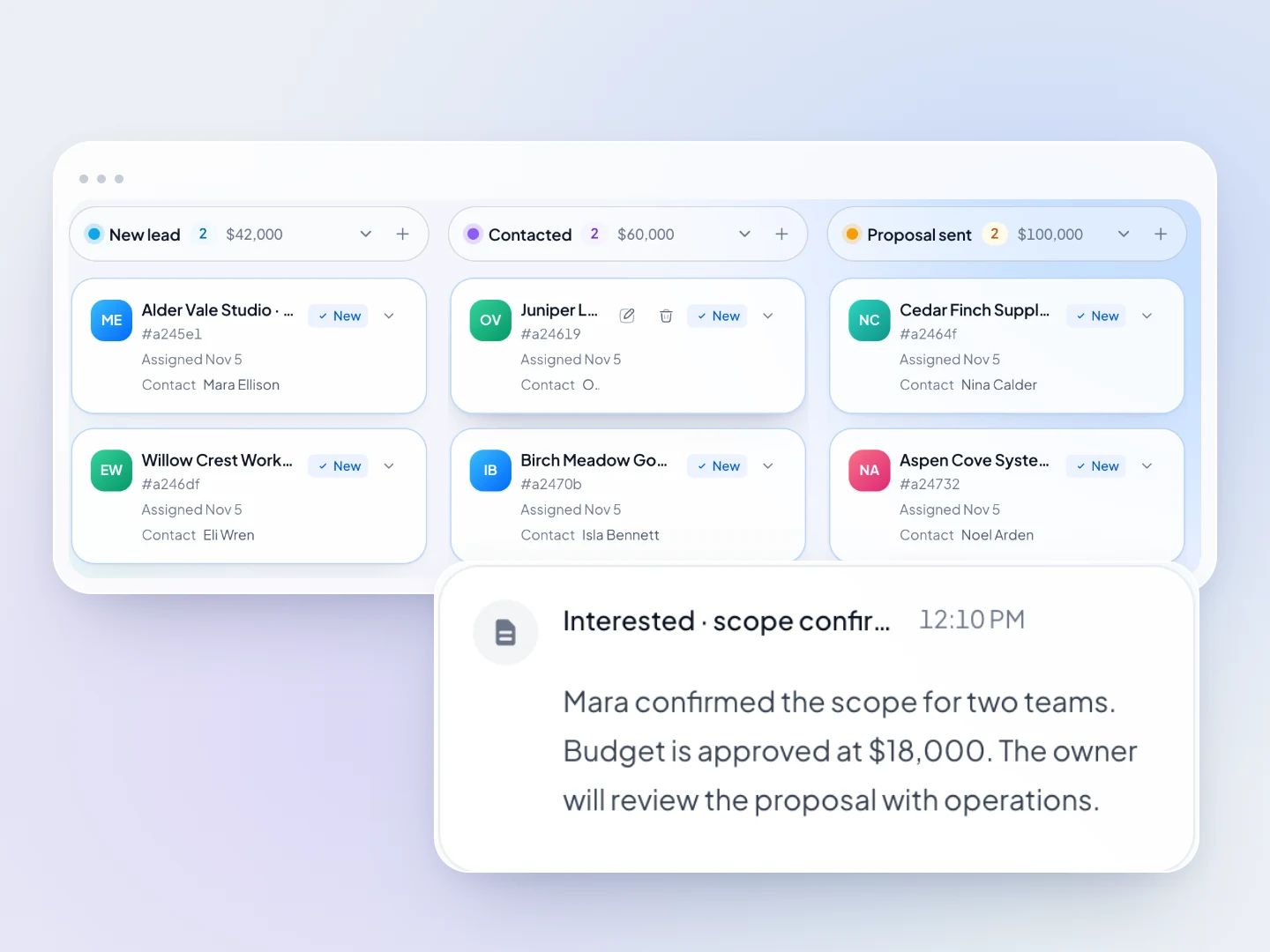
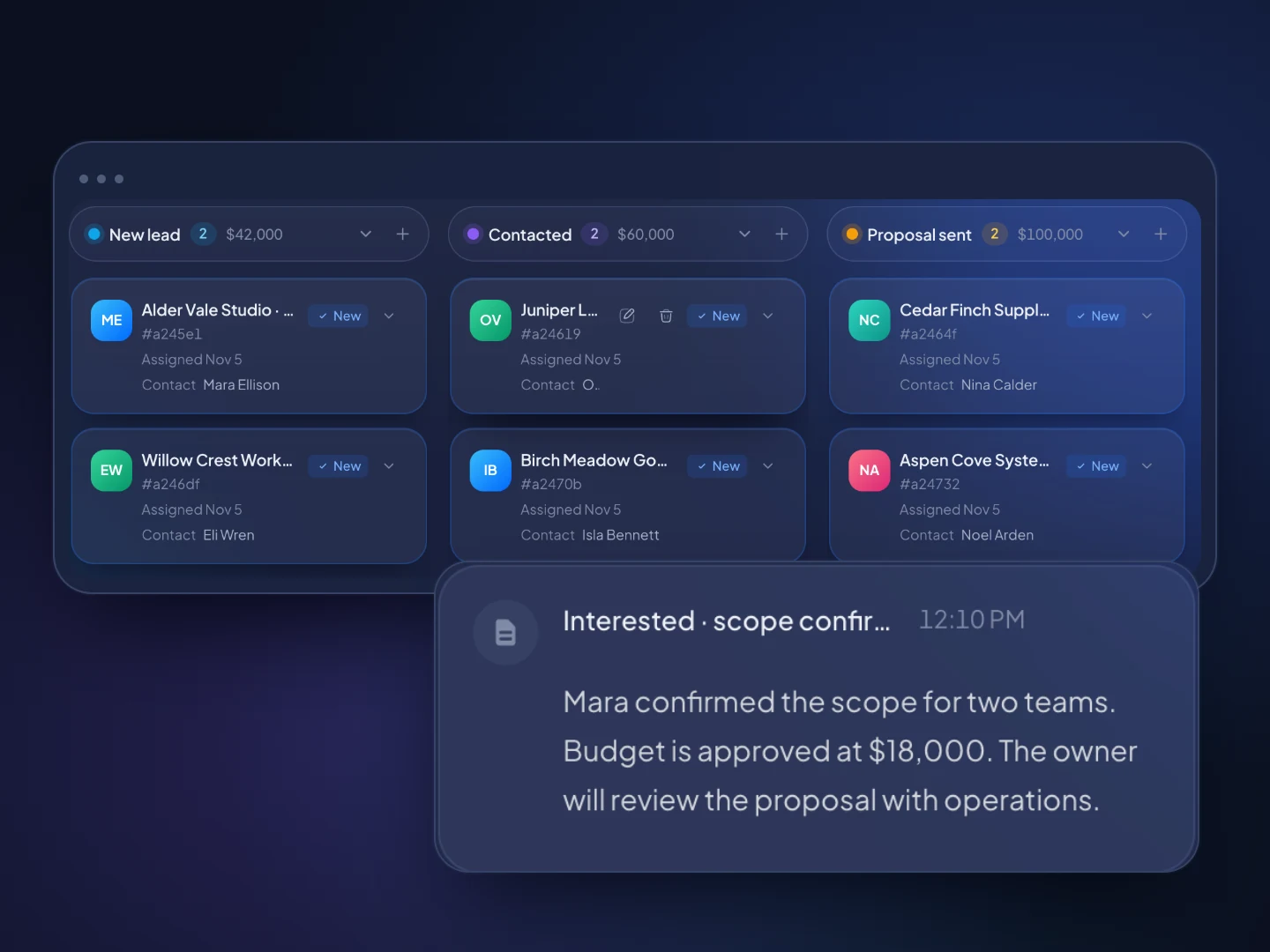
In TopReach, each opportunity is a deal on a drag-and-drop pipeline, and the pipeline shows the value at each stage. Use the expected loan amount or deposit balance as the value, and tag deals Lending or Deposits so the totals aren't mixed. Keep each business as a company with its owners and finance staff as contacts, so a second officer can see who was called and what was said.
Referral sources deserve their own rhythm. Tag each accountant, attorney and realtor, call your best sources monthly and the rest quarterly, and record the source on every deal they send so you can see which relationships produce business.
What should go in custom fields and tags, and what should stay out?
Put in what an officer needs to make the call, and nothing more. Keep account numbers, Social Security numbers, balances, credit reports and loan files in your core and loan origination system. TopReach is for the outreach: who to call, what was said and what happens next.
Custom fields and tags sit on each contact, and saved lists or dynamic lists built from rules on them become your call lists.
- Relationship type: prospect, customer or member, or referral source
- Product interest: commercial real estate, equipment, line of credit, treasury, deposits, auto loan or home equity
- Assigned officer and branch, so lists split cleanly by person and location
- Industry and approximate size for business prospects
- Maturity month for certificate and term deposit calls, rather than the balance
- Application date for loan follow-up
- Referral source, such as the accountant or realtor who sent them
How do you follow up on loan applications?
Call within a business day of an application stalling, then follow a short, fixed schedule. People who start an application and stop often have a question or a missing document, and a call from a named person at the institution can settle it.
A simple consumer loan pipeline uses Application started, Contacted, Documents requested, Submitted, Funded and Withdrawn. When a call isn't answered, TopReach can drop a voicemail and then send a text or an email on the days you choose, and it tracks every touch so nobody gets the same message twice. Each call, text and email saves to the applicant's timeline, so whoever picks it up next can see what was said.
- Day one: call. On a miss, the voicemail drops and a text or email follows.
- Days two to seven: two or three more attempts at different times of day.
- After that: a final email, then move the deal to Withdrawn with a note on why.
- Credit decisions and required notices stay in your loan origination system. TopReach tracks the outreach, not the decision.
How do you run deposit and member outreach?
Run it as short, planned campaigns with a clear list and a clear reason to call. Customers and members are more willing to talk when the call is about something of theirs, like a maturing certificate, than when it's a general pitch.
Text only people who have agreed to hear from you that way, and keep account details out of every message.
- Welcome calls: call new customers or members in their first few weeks to thank them, check the account is set up the way they wanted and ask what else they need.
- Maturity calls: call a few weeks before a certificate or term deposit matures, using a dynamic list built from the maturity-month field, so the customer hears their options from you first.
- Loan recapture: credit unions often call members who have an auto loan elsewhere to offer a refinance. Have compliance approve any rate wording first.
- Calling sessions: some institutions run evening calling sessions with staff from several branches. Leaderboards of conversations and outcomes per caller keep the session focused.
Should a bank or credit union use a power dialer or a parallel dialer?
Use power mode. Power dialing calls one number after another, so whoever answers reaches an officer or staff member, and the next call starts as soon as the last one ends.
Parallel mode calls several numbers at once and connects the caller to whoever picks up. When two people answer, one gets dropped. That can be a fair trade on a big cold list, but customers and members aren't a cold list, and someone who answers a call from their bank to silence may reasonably think it's a scam. Dropped calls also count toward the federal abandoned-call limit.
Both modes come with the same $99-a-month phone licence, but most institutions will use power mode for nearly everything. Local phone numbers that match your branches' area codes help customers recognize the call.
What rules apply to bank and credit union calling?
Banks and credit unions answer to telemarketing law, privacy law and their regulators' expectations for vendors and marketing. Clear any new outreach tool with compliance and vendor management before you load customer data into it. This is a general overview, not legal advice.
TopReach keeps a do-not-call list and handles texting opt-outs across every caller. What your institution may say, to whom and how is for your compliance team to decide.
- Consent: under the TCPA, autodialed or prerecorded calls and texts to cell phones generally need prior express consent, and written consent for marketing calls. A dropped voicemail is a prerecorded message.
- Do Not Call: the FTC's Telemarketing Sales Rule largely doesn't reach banks and federal credit unions, but the FCC's TCPA rules do, including the National Do Not Call Registry, 8 a.m. to 9 p.m. calling hours and a 3% cap on abandoned calls. An established business relationship generally exempts calls to customers and recent applicants from the registry.
- State law: some states have their own telemarketing laws, and some require everyone on a call to agree before it's recorded.
- Privacy and vendors: the Gramm-Leach-Bliley Act governs customer information, and regulators expect institutions to oversee third parties that handle it. TopReach doesn't hold or claim SOC 2 or any other certification, so take it through your normal vendor review.
- Marketing and fair lending: rates and terms in a call script or text can trigger Truth in Lending or Truth in Savings disclosure rules, rules on unfair or deceptive practices apply to what you say, and choosing who to call by geography can raise fair lending questions.
- Canada: the National Do Not Call List rules and CASL apply, and federally regulated banks also answer to the Financial Consumer Agency of Canada.