Guide
How a dealership BDC works the phones, from internet leads to lease-end calls
A dealership business development center lives on the phone: new internet leads, appointment confirmations, unsold showroom traffic and the owners already in your sales and service history. This guide covers how a BDC organizes that work, the pipeline stages and fields worth tracking, follow-up cadence, which dialer mode to use and the calling rules your compliance team should check.
What calls does a dealership BDC make?
A BDC makes five kinds of calls, and each needs its own list, script and goal. Mixing them on one long list is how a fresh lead ends up waiting behind a lease-end campaign.
- Internet leads: new inquiries from your website and third-party listing sites, called back as soon as they arrive.
- Unsold showroom traffic: customers who visited but didn't buy, called the same day or the next with a reason to come back.
- Appointment confirmations: a text, and a call for anyone who doesn't reply, before every visit.
- Service-to-sales: owners booked for service, or in the lane today, whose vehicle or payment makes a trade worth discussing.
- Equity and lease-end: owners whose trade is worth more than their payoff, and lessees nearing the end of their term.
How fast should a BDC respond to an internet lead?
As fast as you can, ideally within minutes, while the shopper is still looking. Research on web leads, including a widely cited Harvard Business Review study, has found that the odds of reaching and qualifying a lead drop quickly as the first response is delayed. Shoppers often send the same inquiry to several dealers, and the first one to hold a real conversation has the best chance at the appointment.
In TopReach, the first unanswered call can set off the rest: a dropped voicemail, then a text or email on the days you choose, with every touch logged so nobody sends the same message twice. TopReach doesn't receive lead feeds from your website or lead providers, so agents add leads as they arrive or import them from a spreadsheet.
Make speed someone's job. Decide who owns new leads at every hour the store is open, and give agents a first-day plan, such as this one, so a missed call doesn't become a forgotten lead:
- Minute one: call. If there's no answer, leave a short voicemail that names the vehicle and gives a reason to call back.
- Right after: if the customer agreed to texts, send one that answers their question and gives a direct number.
- Within the hour: an email with what they asked about, such as availability, photos or a price.
- Later the same day: a second call at a different time.
- After day one: a call or text every day or two for the first week, then weekly through the first month, then a monthly check-in.
What pipeline stages and fields should a dealership track?
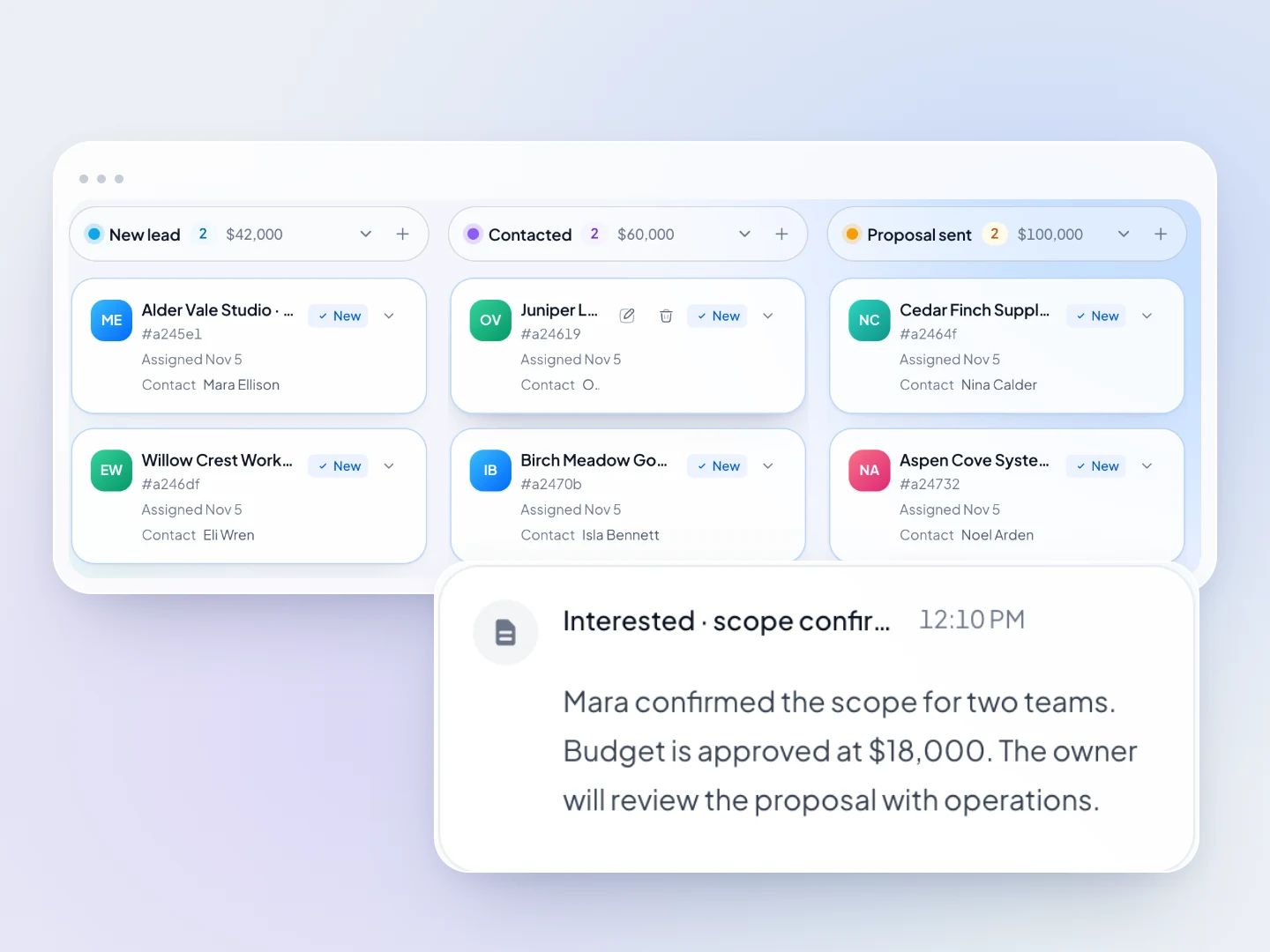
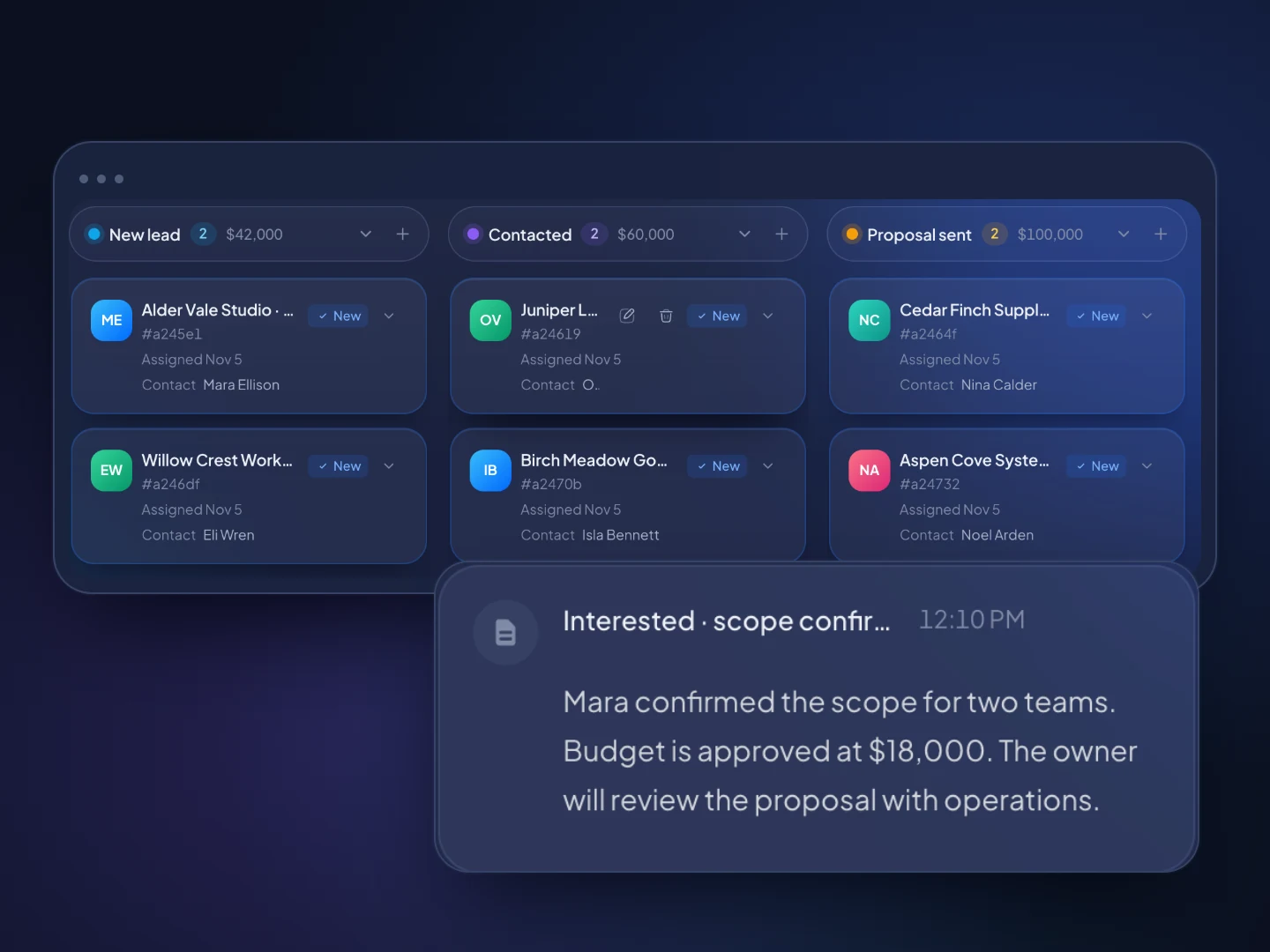
Track every opportunity from first contact to sold on one board, with stages that match how your store sells. A typical setup in TopReach's deals pipeline uses New lead, Contacted, Appointment set, Confirmed, Showed, Sold and Lost, with a reason on every lost deal, such as bought elsewhere or stopped shopping. Each deal carries a value, and the pipeline shows the value at each stage.
Equity figures, payoffs and maturity dates come from your DMS or equity tool. TopReach doesn't connect to your DMS, so export those figures to a spreadsheet and import them.
The call screen shows the contact, their last note and the next step, so put what an agent needs in the seconds before a call into custom fields and tags:
- Vehicle of interest, or the current vehicle with year, make, model and mileage
- Lead source, such as your website, a listing site, a referral or a walk-in
- Assigned salesperson and BDC agent
- Lease maturity or finance payoff date, and estimated equity
- Last service date and next service appointment
- Tags such as Internet lead, Showroom, Orphan owner, Lease end or Service customer
How do you run service-to-sales, equity and lease-end campaigns?
Run them as separate campaigns on lists of people who already do business with you, and give them to your best phone agents. These owners have history with your store, so each conversation matters more than the dial count.
Dynamic lists in TopReach fill themselves from rules on your fields and tags, so a lease-end or equity list picks up new owners each time you import updated figures. How each campaign works:
- Service-to-sales: build the list from upcoming service appointments and recent repair orders, and flag high-mileage vehicles and large repair estimates. Call before the visit to set a quick appraisal while the car is already in.
- Equity: call owners whose estimated trade value is above their payoff, with a specific reason to talk, such as a newer vehicle at a similar payment.
- Lease-end: start several months before maturity, so the customer hears your options before another store's. Call again as the date gets close, and text a reminder about turn-in or pull-ahead options.
- Orphan owners: introduce their new contact person and offer service or an appraisal.
How should a BDC confirm appointments and cut no-shows?
Confirm every appointment by text the day before and again on the morning of the visit, and call anyone who doesn't reply. A confirmation gives the customer an easy way to reschedule instead of simply not coming.
In TopReach, set a reminder task for each confirmation. The agent sends the text from the customer's record, replies land in a shared inbox the whole BDC can answer, and the agent moves the deal to Confirmed when the customer replies.
When someone misses an appointment, call the same day. A quick, friendly call to reschedule keeps the conversation going, and the outcome goes on the timeline for whoever calls next.
Should a dealership use a power dialer or a parallel dialer?
Use power mode for nearly all dealership calling. A power dialer calls one number after another, so whoever answers reaches an agent who already sees their record. That is what fresh leads, appointment confirmations and your own owners deserve.
A parallel dialer calls several numbers at once and connects the agent to whoever picks up. It can produce more conversations per hour on a big list where most calls go unanswered, but when two people answer at once, one gets dropped. That's acceptable on a big cold list and wrong for someone who just asked about a vehicle or has bought from you twice. If you use parallel mode, keep it for large aged lists, check that the people on them can still be called and watch your abandoned calls.
Both modes come with the same $99-a-month phone licence, so you can choose the mode list by list.
What calling and texting rules apply to dealerships?
Dealership calls and texts fall under federal telemarketing and consent rules, state laws and, for Canadian stores, CRTC rules and CASL. This is a general overview, not legal advice. Check with your counsel or compliance team before you start a campaign.
TopReach keeps a do-not-call list and handles texting opt-outs across every agent, so one customer's request applies to the whole store. Whether a given call or text is allowed is still a decision for you and your counsel.
- Cell phones: under the TCPA, autodialed or prerecorded calls and texts to cell phones generally need prior express consent, and prior express written consent when they're marketing. A dropped voicemail is a prerecorded message.
- Do not call: the established business relationship exemption from the National Do Not Call Registry generally covers people who bought or serviced a vehicle with you in the last 18 months, or inquired in the last three months. An aged internet lead may need a registry check before you call, and the exemption ends when someone asks you to stop.
- Abandoned calls: the Telemarketing Sales Rule and the FCC's rules cap abandoned calls at 3% of answered calls per campaign over 30 days. A call counts as abandoned when the person isn't connected to a rep within two seconds of answering, which is what happens to the extra answer in parallel mode.
- Calling hours and state laws: federal rules limit sales calls to between 8 a.m. and 9 p.m. local time, and several states, including Florida and Oklahoma, have their own telemarketing laws with tighter rules.
- Call recording: some states, including California and Florida, require every party's consent to record a call, so tell customers when calls are recorded.
- Customer data: dealers that arrange financing are covered by the FTC Safeguards Rule. Keep credit applications and deal documents in the systems built for them.
- Canada: the National DNCL has its own existing business relationship exemption (18 months after a purchase or lease, six months after an inquiry), and CASL covers texts and emails.