Guide
How consultancies run business development by phone
Most consulting firms win work through relationships: referrals, past clients, events and a short list of companies they'd like to work with. The phone is how those relationships turn into meetings. This guide covers building a target account list, calling decision-makers, following up after events and referrals, running a proposal pipeline, which dialer mode to use and the rules that apply to business calls and emails.
Why do consultants still use the phone for business development?
Because a conversation moves a consulting sale faster than anything else. Buyers hire consultants they trust to understand their problem, and a ten-minute call shows that in a way an email can't.
Partners and senior consultants make many of these calls themselves, sometimes with a business development rep booking first meetings. Either way, every call and note should land on one shared record, so nobody calls a client's CFO without knowing a partner spoke to them last week. Phone work in a consultancy usually falls into four kinds of calls:
- Target accounts: a planned list of companies that fit your services, called to open a conversation with the right decision-maker.
- Event follow-up: people you met at a conference, a talk or a webinar, called while they still remember the conversation.
- Referrals: introductions from clients and partners, which deserve a call the same day or the next.
- Past clients and dormant contacts: check-ins that often lead to the next engagement.
How do you build and work a target account list?
Start with a narrow list of companies where you've solved the same problem before, and the people at each one who own that problem. A short list worked thoroughly usually does more than a long list called once.
TopReach doesn't supply prospect lists or contact data. Build the list from your own research or a data provider you already use, export it to a spreadsheet and import it; the import finds the phone number in whichever column it's in.
A workable cadence for a target account is six to eight touches over three to four weeks: a call, a short voicemail and an email on day one, then calls on different days and times, and an email that shares something useful rather than asking again. After the last touch, move the contact to a quarterly check-in instead of dropping them. In TopReach, an unanswered call can trigger part of that cadence for you: a dropped voicemail, then a text or email on the days you choose, logged on the contact.
What to record on each account, in custom fields and tags:
- Company: industry, size or revenue band and location
- Contact: role, and whether they're the decision-maker, a sponsor or an influencer
- The service you'd offer, and the trigger that makes now a good time, such as a new leader, an acquisition or a system change
- Source: target list, event, referral partner or past client
- Tags such as Tier 1, Referral, Past client or the event name, which dynamic lists can use to build call lists that fill themselves
How should you follow up after events and referrals?
Quickly and personally. After an event, call within a few days, while people remember you, and mention something specific you talked about. After a referral, call the same day or the next, and thank the person who made the introduction.
Every call, text and email lands on the contact's timeline, so when a colleague picks up the follow-up they can see what was said and sent. A simple routine:
- Import the event list or your notes the day you get back, tagged with the event name.
- Call the people you spoke with first, then the rest of the list.
- After each conversation, send a short email or text with whatever you promised, such as an article, a short case summary or times to meet.
- For referrals, record who referred them in a custom field, and let the referrer know when you've spoken.
- For anyone who says 'not now', set a reminder for when they suggest.
What pipeline stages should a consulting firm use?
Use stages that mark real commitments from the buyer, not activity on your side. A common set is Target, Contacted, Discovery call, Scoping, Proposal sent, Verbal yes, Won and Lost.
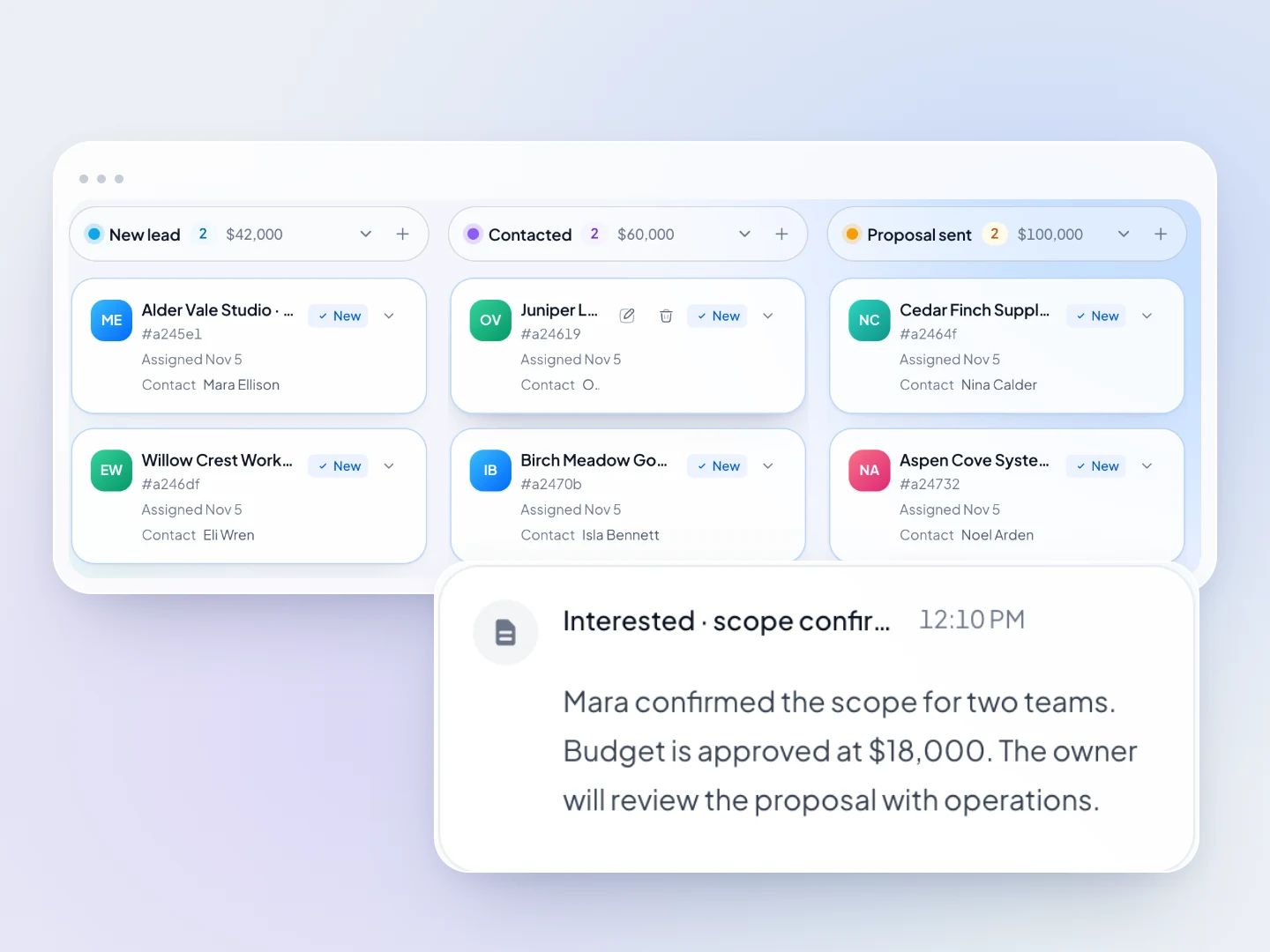
Each opportunity carries its value, and TopReach's pipeline shows the value at each stage, so you can see how much is in proposals and how much is still only a conversation. Drag deals between stages as they move, and set a task for every open proposal with the date you agreed to follow up.
TopReach doesn't write proposals or collect signatures, so keep using your document and e-signature tools and record the outcome on the pipeline. Habits that keep proposals moving:
- Agree on a decision date during the proposal conversation, and record it.
- Call, rather than email, a day or two after the proposal goes out, to answer questions.
- If a proposal stalls, ask what changed; a stall often means a new priority rather than a no.
- Record a reason on every lost deal, such as budget, timing, chose another firm or did it in-house.
What happens after the sale?
The engagement starts, and business development turns into account management. TopReach includes projects for work after the sale, so a won deal can be tracked as a project in the same workspace where the client's calls, emails and notes already are.
Keep calling during the engagement. Regular check-ins with the sponsor surface the next problem worth solving, and a call near the end of a project is a natural time to ask about follow-on work or a referral. TopReach doesn't track time or send invoices, so billing stays in your accounting system.
Tasks and reminders keep these calls on the calendar instead of in someone's head. A simple rhythm for active clients:
- A short check-in call with the sponsor every two to four weeks, logged on their timeline.
- A reminder a month before the engagement ends to talk about what comes next.
- A call a few months after the project closes to see how the results are holding up.
- A thank-you and a brief update for whoever referred the client, within what the client is comfortable sharing.
Should a consultancy use a power dialer or a parallel dialer?
Use power mode for almost all consulting business development. Power dialing calls one number after another, so whoever answers reaches you with their record on screen, and a senior buyer who picks up is never dropped.
Parallel mode calls several numbers at once and connects you to whoever picks up. When two people answer at once, one gets dropped. That's a reasonable trade on a large cold list, such as a few thousand companies in a new market you're testing, and the wrong one for target accounts, referrals or past clients.
Both modes come with the same $99-a-month phone licence, so you choose the mode list by list.
What rules apply to business development calls and emails?
Business-to-business calls get some exemptions, but not from every rule. This is a general overview, not legal advice; check with your counsel before you start a campaign.
TopReach keeps one do-not-call list and handles texting opt-outs across the team, so one request applies to everyone.
- Do not call: most business-to-business calls are exempt from the US National Do Not Call Registry and much of the Telemarketing Sales Rule, though a sole proprietor's cell phone may count as a personal number. In Canada, calls to businesses are exempt from the National DNCL rules but not from the CRTC's other telemarketing rules.
- Cell phones: under the TCPA, autodialed or prerecorded calls and texts to cell phones generally need prior express consent, whether or not the phone is used for business. A dropped voicemail is a prerecorded message.
- Abandoned calls: if you use parallel mode, dropped calls count toward the 3% abandoned-call limit in the TSR and the FCC's rules, measured per campaign over 30 days. Ask your counsel how it applies to your campaigns.
- Emails and texts to Canadians: CASL requires consent for commercial emails and texts, including most business-to-business messages. Implied consent can apply when someone publishes their business email without saying they don't want messages, and your message relates to their role.
- Call recording: some states, including California and Florida, require every party's consent to record a call.